

How To Set Task Scheduler In Windows Server 2008
If you would like to read the next role in this article series please go to Working with the Windows Server 2008 Task Scheduler (Part 2).
The Windows Task Scheduler is practically as one-time as Windows itself. It has been around since at least Windows NT 4.0, and has evolved relatively little over the years. Since the days of Windows NT, the Windows Chore Scheduler has existed in the form of a command line tool called AT.
The AT was used to run tasks at a specific time. Although AT worked actually well, it required the administrator to enter a number of complicated control line switches.
Somewhere along the way, Microsoft introduced a graphical interface to the AT tool (I recall information technology was beginning released in the Windows 98 Resource Kit, only I can't remember for certain). This tool, chosen WinAT, greatly simplified the process of using the Windows job scheduler, but for some reason information technology just never seemed to have caught on with administrators.
Although the AT command is alive and well in Windows Vista and in Windows Server 2008, Microsoft has finally brought the Windows Job Scheduler into the twenty start century. The AT control hasn't actually changed at all though. In fact, if you look at the screen capture shown in Figure A, you can run into that the Windows Vista version of the AT control looks the same as what was used in much older versions of Windows.

Figure A: The Windows Vista version of the AT command looks like what you would find in much older versions of Windows
The Windows Vista and Windows Server 2008 versions of the Task Scheduler offer many more capabilities than what accept previously been included in the Windows Task Scheduler, but these new capabilities are non exposed through the AT command. Instead, at that place is a new GUI console that provides you with access to all of the new capabilities. In Windows Server 2008, you can access the new and improved Windows Job Scheduler by opening the Server Managing director and navigating through the console tree to Server Manager | Configuration | Task Scheduler. You can see what this console looks like in Figure B.
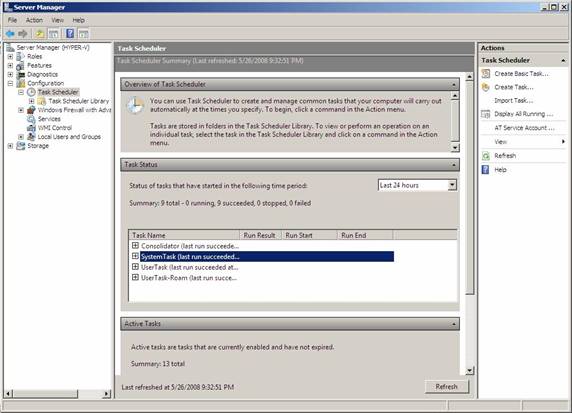
Figure B: The initial Windows Job Scheduler screen displays all of the tasks that have completed in the terminal 24 hours
Triggers
I of the biggest differences between the Windows Server 2008 / Windows Vista job scheduler is the number of triggers that are bachelor. A trigger is an outcome that causes the scheduled activity to occur. If yous are using the AT command as an interface to the Windows Task Scheduler, then the only trigger that is bachelor to you is a schedule trigger. For example, you tin configure the Windows Job Scheduler to perform an activeness at a specific date and time. You lot have the selection of making the result recurring, only that'south really most it every bit far as trigger options go.
If you use the new graphical interface for the Windows Job Scheduler, you still have the option of creating scheduled triggers, only in that location are a lot more than options that are available to you besides. Some of the other triggers that are offered include:
-
At Log On
-
At Startup
-
On Idle
-
On an Event
-
At Task Cosmos / Modification
-
On Connection to User Session
-
On Disconnect from User Session
-
On Workstation Lock
-
On Workstation Unlock
Every bit you can imagine, these various types of triggers give you a lot of flexibility. For example you could create a task that automatically runs a script when a sure system event occurs. Likewise, y'all could create a job that displays a security warning message each time a user unlocks their computer.
Deportment
Just equally Microsoft has created lots of new types of schedule triggers, they have also given you more options when it comes to performing an action once a trigger occurs. If you've ever worked with the AT command, then you know that previously your only choice for performing an action was to run a command. This control could be an executable program, or it could be a batch file.
The Windows Task Scheduler GUI in Windows Server 2008 still allows you to execute a command when a trigger occurs, just that isn't your just option. You besides have the choice of sending an Email message (with an optional zipper) or of displaying a message in a window on the machine on which the trigger has occurred.
Technically speaking, all of these options are possible when using the AT command. The difference is that if you want to use the AT command to send an Email message or to brandish a text message, then you would accept to write a script that would generate the message, and so prepare a task that would launch the script at the scheduled fourth dimension. Windows Server 2008 frees you from having to exercise the scripting, considering it offers built in tools for sending E-mail letters of displaying text letters. All you lot have to exercise is to fill in the various fields.
Conditions
The nice affair about the Windows Server 2008 Task Scheduler is that it also allows you to control the conditions under which a trigger takes effect. For example, you may only desire the scheduled task to run if the figurer is running on Air-conditioning power, and non if it is running on bombardment. Likewise, if the computer is in hibernation, you lot need to make up one's mind if the computer should wake upwards to perform the triggered job, or if you would adopt for the computer to stay asleep.
If Windows is running on a laptop, then there may be times when a network connection is unavailable. If the triggered task is network dependant, then it would be pointless to run the task if the task requires network connectivity, then yous will demand to tell Windows whether or not the task is network dependant.
These are all examples of conditions that tin can bear on the way that a chore tin can run. As you can see in Figure C, Windows allows you to pre-configure these, and other conditions so that the Windows Chore Scheduler knows under which circumstances to run a triggered task.
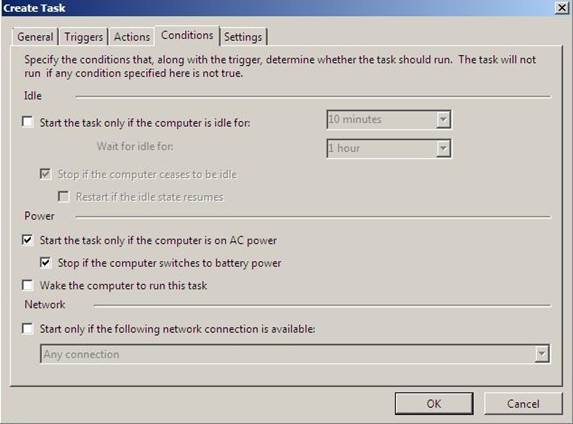
Effigy C: Windows provides a number of optional weather condition that you tin configure
Settings
Settings are similar to weather, but are used once the triggered task is already running. For example, a setting will permit you lot to tell Windows what to exercise if the triggered task fails, or if it runs for an excessive length of time. You can likewise use settings to strength a chore to stop under certain situations or even to automatically delete an expired task. You can see the settings that are available to you lot in Effigy D.

Effigy D: Settings allow you to control how a task behaves once information technology starts
Conclusion
In this commodity, I have talked about the basic components that brand upward the new and improved Windows Task Scheduler. In Office 2 of this article series, I will show you lot how to create a chore, and talk about some of the congenital in tasks.
If you lot would like to read the next role in this article series please go to Working with the Windows Server 2008 Task Scheduler (Part two).

How To Set Task Scheduler In Windows Server 2008,
Source: https://techgenix.com/working-windows-server-2008-task-scheduler-part1/
Posted by: martinomaire1951.blogspot.com
0 Response to "How To Set Task Scheduler In Windows Server 2008"
Post a Comment